On 1st October, CUCU Mare (Development of a cross-border institutional response to encourage circular aquaculture for cleaner seas based on mussel and sea cucumber farming) officially launched. Funded by the Interreg Italy-Croatia 2021-2027 programme, the project brings together Sea the Change, Zadar County Development Agency ZADRA NOVA, Cooperative Society, Ruđer Bošković Institute and Mediterranean Aquaculture Association, to test and promote circular aquaculture through the integrated farming of mussels and sea cucumbers.
Aquaculture: a growing sector
Global aquatic food production more than tripled between 1997 and 2017, while global demand for fish is projected to increase by 13% by 2034, highlighting the growing importance of aquaculture in meeting future demand (OECD/FAO, 2025).
Today, aquaculture accounts for approximately 49% of global aquatic animal production (The State of World Fisheries and Aquaculture, FAO, 2022). In Italy alone, aquaculture product consumption increased by 3.6% in volume in 2025.
Opportunities and challenges
Aquaculture can play an important role in meeting the growing demand for aquatic food products, providing a source of protein that can reduce pressure on wild fish stocks and contributing to Sustainable Development Goal 2 (SDG 2) of the UN 2030 Agenda, which aims to end hunger. When responsibly managed, it can also have a lower carbon and environmental footprint than other forms of animal production, such as livestock farming (European Commission, EU Aquaculture).
However, the sector’s sustainability depends on several factors, including management practices, site selection, production methods and the use of chemicals and veterinary medicines. Other concerns include the potential escape of farmed organisms and the resulting impacts on wild populations (Aquaculture and Nature-based Solutions: Identifying Synergies Between Sustainable Development of Coastal Communities, Aquaculture, and Marine and Coastal Conservation, IUCN, 2022).
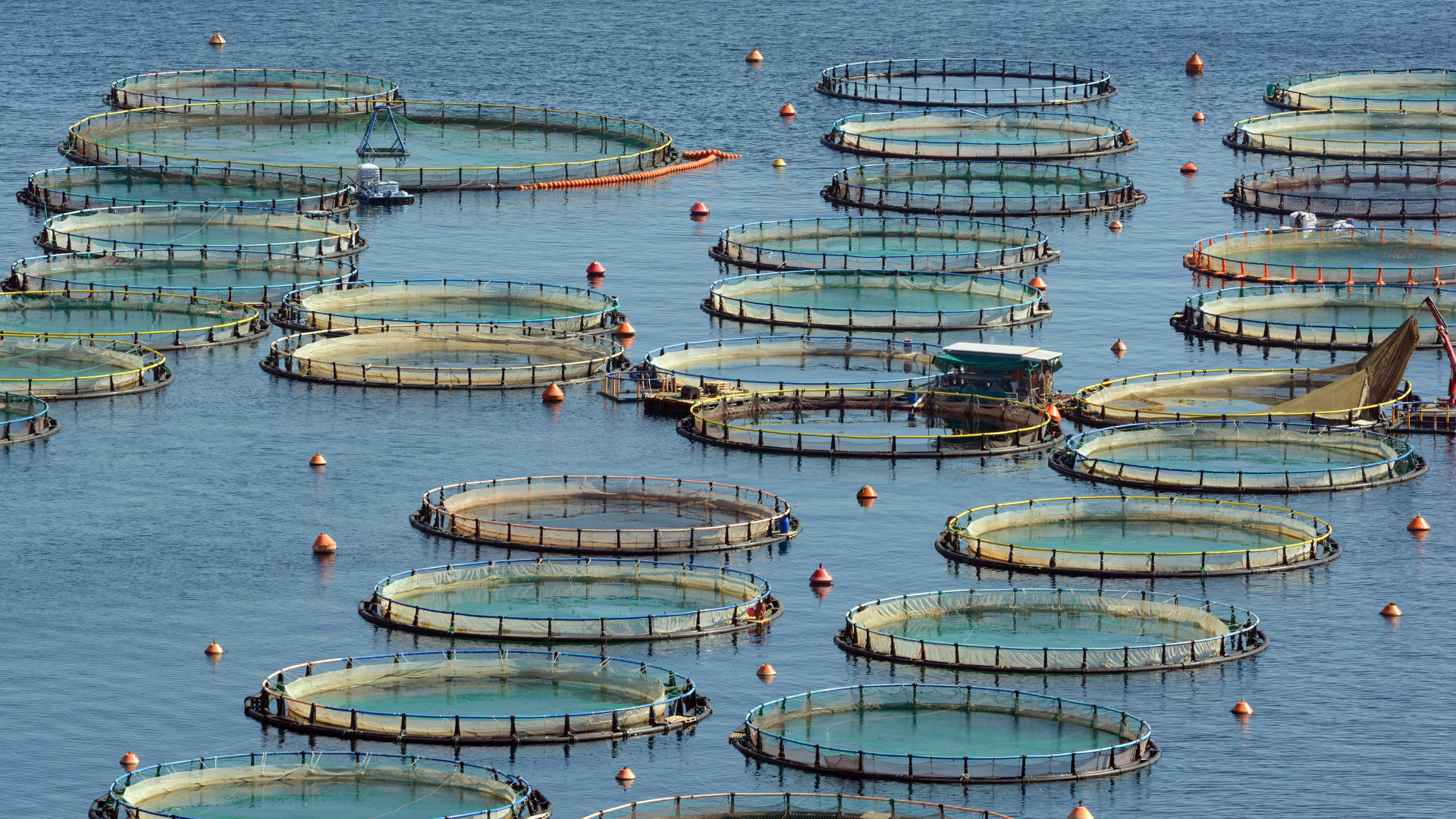
One of the main environmental concerns associated with aquaculture, particularly in open-net pen systems, is the accumulation of organic waste from fish excretions, uneaten feed and other metabolic products. When these inputs are not adequately managed, they can affect water and sediment quality, contributing to nutrient enrichment and eutrophication (Serpa and Duarte, 2008). These changes can, in turn, disrupt ecological balance and affect benthic communities (Elvines et al., 2023).
Feed production presents another major challenge. According to the European Commission, carnivorous species account for approximately one-quarter of aquaculture production by volume, and their feed often relies on fishmeal and fish oil derived from wild-caught fish. The shift towards alternative ingredients, such as insect meal and microalgae, remains limited. In 2020, these alternatives accounted for just 0.4% of the ingredients used in salmon feed. This highlights a key contradiction: while aquaculture has the potential to reduce pressure on wild fish stocks, it still relies on marine resources to feed farmed species (Medium- and large-scale aquaculture, UN, 2026).
To address these challenges, the European Union has developed a strategic framework to support a more sustainable and competitive aquaculture sector. The European Commission’s Strategic Guidelines for a More Sustainable and Competitive EU Aquaculture for the Period 2021–2030 outline key priorities, including strengthening environmental monitoring at aquaculture sites, reducing waste generation, promoting circular economy practices, ensuring sustainable feed sourcing and limiting the use of pharmaceuticals, including antimicrobials and antiparasitic substances, which can harm the environment and contribute to antimicrobial resistance (González-Gaya et al., 2022).
Innovation as a turning point: Integrated Multi-Trophic Aquaculture (IMTA)
As the name suggests, Integrated Multi-Trophic Aquaculture (IMTA) combines the farming of aquatic species from different trophic levels, each with distinct nutritional needs, within the same system. The aim is to create a more balanced and resource-efficient system in which waste generated by one species becomes a resource for another. Inspired by natural ecosystems, where nutrients are continuously recycled and reused, this approach helps minimise waste while making better use of available resources (Aquaculture and Nature-based Solutions: Identifying Synergies Between Sustainable Development of Coastal Communities, Aquaculture, and Marine and Coastal Conservation, IUCN, 2022).
IMTA can be implemented in different types of farms, both on land and at sea, by combining fish farming with the cultivation of seaweed and the farming of bivalves, for example. These systems aim to minimise waste and maximise resource efficiency. The overall result? A more efficient and resilient system, with lower environmental impacts, reduced consumption of external resources (e.g. fertilisers and feed), cost savings and opportunities to diversify production.
IMTA is therefore considered a promising approach to advancing the European Union’s objectives for a more sustainable and competitive aquaculture sector by 2030 (European Commission, EU Aquaculture). Growing interest in this approach is also reflected in research and innovation initiatives across Europe and beyond, including BLUEBOOST, PHAROS, ASTRAL and AquaVitae.
Why CUCU Mare?
Despite the recognised benefits of Integrated Multi-Trophic Aquaculture (IMTA), scaling up its implementation remains a challenge (Medium- and large-scale aquaculture, UN, 2026). Research and pilot projects, including those mentioned above, have demonstrated the potential of this approach, yet its wider adoption continues to face significant barriers. These include the need to develop solutions tailored to local environmental and production conditions, as well as to strengthen political and institutional support for their implementation.
CUCU Mare aims to contribute to this effort over the next 36 months by testing the integrated farming of mussels and sea cucumbers. Beyond improving farming techniques, the project will strengthen cross-border institutional cooperation between Italy and Croatia, support knowledge transfer and encourage the exchange of expertise among the partners and stakeholders involved.
Stay tuned to our channels for the latest news and developments from CUCU Mare!